Showing posts with label fiction. Show all posts

Monday, December 17, 2012

Burning Hobbit Experience

Getting ready to see The Hobbit: An Unexpected Journey has been an unexpected rollercoaster for me. My emotions have ranged from hope and excitement when the movie was first announced, to joy and delight at the initial trailers and sneak peeks, to fear and dismay when they announced that they were stretching the movie to two, and then three movies, to disgust and despair when I learned about exactly how they were padding the movie to triple ticket sales, and finally back to a tentative hope when reviews from friends and Internet acquaintances showed that it wasn't as bad as it was feared, and might actually good.

I'll be straight with you here: my feeling swelled to glory and delight with the opening scenes... and quickly descended into a solid, abiding disappointment - the kind where there aren't enough good things to talk about without dipping into things that were "ok" or "could have been worse."

Will I see the next two movies? Certainly, and not just because it's The Hobbit. Will I love them in the same way that I loved the Lord of the Rings films? Is The Hobbit film a similarly brilliant testament to a sub-culture's love of a seminal text? No on both counts. The Hobbit: An Unexpected Journey is mediocre at best, actively bat at times, and contains only a few gems of true greatness.

Let's break it down.

The Good

The first thing I liked about this is a weird one, because I'm also going to criticize it: the much-storied frame rate. 48 frames per second created a weirdly crisp image. Overall, however, I liked it. It was sharp, dynamic, and realistic. I'm looking forward to seeing more movies filmed and presented in this way.

The phrase, however - "looking forward" - is key. I feel like the director didn't quite know what to do with this new technology. The special effects weren't up to the task of the greater frame-rate, and looked unrealistic and pasted on. The customs and prosthetics that made the orcs orcs and the wargs wargs made them look like muppets. Even some basic movie things, like lighting and colors, weren't quite right.

But I'm patient. These things take time. I'd rather see movie-makers attempt to move into the world of this new and crisper technology than sit back and hang out in the world of the old, tired technology, just because they're afraid to be the first. I don't mind that they started with The Hobbit - in fact, I'm honored. Just... get better at this, ok? I felt like I was watching a moderate-budget BBC historical rather than an epic tale of, well... The Hobbit.

Also despite those problems, some of the visuals were striking. The first glimpse of Rivendell, for example, was as beautiful as it always was. The shots of Erebor, for example, and the way they contrasted with the probably-it-has-a-name-but-I-can't-be-bothered-to-find-it-out goblin city, were pure gold.

I also feel like the creators did a good job of capturing the spirit of The Hobbit. Oh, sure, there were problems - and you'll hear about them in good time - but their hearts were clearly in the right place. This was still the Middle Earth we all know and love, just a little brighter, gentler, and sillier. In other words, this was Middle Earth at the end of the long peace that preceded the War of the Ring.

Finally, there were the changes I liked. I know this is a sore topic among my fellow nerds, but I have long subscribed to the belief that some things need to change when a book becomes a movie and when an old work (guys, The Hobbit is 75 freaking years old) becomes new.

I liked that the dwarves developed distinct personalities and styles - even if it meant that Fili, Kili, and Thorin became man-candy. Let's face it, The Hobbit had four characters: Bilbo, Gandalf, Thorin, and Bob the Dwarf Blob. While that might have flown in the 30s, it doesn't work with modern audiences and isn't actually good writing. Giving the dwarves distinct styles, writing them some actual dialogue that actually distinguishes them, is all to the good.

I also liked some of the Silmarillion-esque digressions. The initial digression I could have lived without - the 1977 animated version did just as well in a third of the time by turning the dwarf song into a brief flashback - but I rather enjoyed the scenes that showed Gandalf's maneuvering and manipulation behind the scenes. Sure, the stuff about Radagast was kind of odd, and I'm not sure why they decided that they had to make the Necromancer (AKA Sauron in a funny hat) a modern occurrence, rather than something Gandalf had dealt with already... but all in all, it was a fun digression and it added to the sense of building tension, that this fantasy romp was more than it seems.

Because as we all know, it is.

Finally, I can't leave without talking about the songs. Tolkein's songs are another controversial point. Some of us can't live with 'em, some of us can't live without 'em. I'm one of the latter. I still sing the songs from the '77 Hobbit when I'm bored. I enjoyed this movie's rendition of That's What Bilbo Baggins Hates and Under the Misty Mountains Cold. I'm glad the creators of this movie chose to include them, and feel that they added a lot to the atmosphere.

The Meh

What could I have taken or left? Where's the "meh?"

First of all, as I mentioned previously, I wasn't a fan of Dwarven History 101 with Professor Mithrandir. Perhaps it really was too much. Perhaps it's just because I've seen that twenty minutes of movie handled with a five minute monologue (thank you, '77 Hobbit). Either way, I thought it was, frankly, sloppy.

Secondly, I just wasn't impressed with the violence of the movie. It didn't break my heart, either, but the fact is that they managed to cram eleven fight scenes into the first movie alone. Eleven! The Hobbit is supposed to be a story about how "if more of us valued food and cheer and song above hoarded gold, it would be a merrier world." Frankly, The Lord of the Rings is about the same thing, but at least that story is intended to be story of the heroism of folksy regular Joes against a backdrop of the horrors of war. The Hobbit was not as bloody as The Lord of the Rings for a reason... a reason that the creators of this movie seem to have forgotten.

Ultimately, however, I wasn't surprised. Just a little sad that we live in a world where gore and glory is so important. "If more of us valued food and cheer and song" indeed.

Finally, there were moments that just seemed mailed in. The Goblin King is one example. He didn't sound like a goblin or move like a goblin. He spoke clearly and moved like the final boss of the Gobling City level of the inevitable video game. He was a joke, a delivery engine for one-liners, and a midboss, and it was a missed opportunity. Similarly, Azog (pardon me - Azog the Defiler) was insufficiently nuanced to be a three-dimensional villain and insufficiently evocative to be a force of nature villain.

The Bad

I know I try to be the kind of nerd who appreciates the need for change, but there's one - and only one - thing that just pissed me off, and it's a change, and I think I can make an argument for it.

Azog the motherfucking Defiler.

Seriously, was that really necessary?

The Hobbit already has a personified villain. It has Smaug. It already has plenty of midbosses, from the Great Goblin to the giant spiders of Mirkwood and the King of the Wood Elves. It has metaphorical villains in the suspicion and selfishness of the Dwarves, the clannishness and cowardice of the Hobbits, and, in the background, the fears of the Elves and the weakness of Men. The Hobbit didn't need Azog or rather, it shouldn't have needed him. Honestly, he was a cheap trick, included as a sloppy patch for the inertia the project lost by being between one and two movies too long.

The Last Math

In the final arithmetic (see what I did there?), The Hobbit: An Unexpected Journey was mediocre. In this effort, Peter Jackson's reach exceeded his grasp, and the studio's mercantilism exceeded his spirit. This movie may have been a labor of love, but not the kind of love that really understands and cherishes. I don't doubt that Jackson loves The Hobbit, but he he doesn't understand it. He wants to take The Hobbit out on a date, but doesn't get what The Hobbit really wants. He dragged The Hobbit out to see a movie and paint the town red, but The Hobbit really just wanted to cuddle in front of the fire, maybe watch a rom-com on Netflix.

What we have here isn't really The Hobbit. It's the Star Wars prequel. It's The Lord of the Rings: Part 0. It isn't bad, but it isn't good. It was fun, but I've basically already forgotten it.

Tuesday, June 12, 2012

Daughter of Smoke and Zeppelins

I guess the universe wanted to let me know that I was making the right choice. Within two days of deciding to drop this drabble-a-day business, I had a great idea for a new short story, and I was able to start it last night while the quiches were in the oven (long story - don't ask). I won't say anything else until the story is written, but for now suffice it to say that some day soon we will all be giving thanks to the God of Impossible Things...

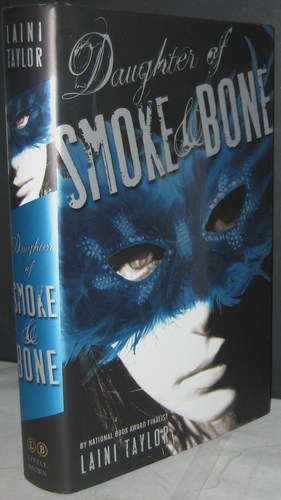
In any case, that's not what I actually wanted to post about today. Today, I wanted to write a long-awaited (but oddly timely) review of a book I enjoyed hugely: Daughter of Smoke & Bone, by Laini Taylor. Daughter of Smoke & Bone will always have a special place in my heart as the first book I ever listened to as an audio book (available through Audible). The reading is brilliant in every possible way, and it's part of what sent me down the path of audiobooks.

Audiobooks are not what I'm hear to talk about, however. I'm here to talk about Karou.

Karou is an art student in Prague. Her hair grows in blue (not rainbows, but it'll do). Unbeknownst to her friends - including the Fierce and Tiny Zusana - Karou was raised by a very strange family of chimerical humanoids led by a bull-headed dragon-bodied wish-merchant named Brimstone. Karou is a daughter of three worlds: the human world that her body makes her a part of, the tiny world of her family and Brimstone's shop where he buys teeth and sells wishes, and a third, mysterious world - the world beyond the other door in Brimstone's shop - a world she has never visited, but feels drawn to nonetheless. Karou's desire to explore this other world - and that world's troubles, pursuing her - will draw her into... well, an adventure. There are also star-crossed romances, buried secrets, and a great many things that are not what they seem.

What I love most about Daughter of Smoke & Bone was the skillful way Taylor builds her story. This is an incredibly tight novel - barely a wasted letter, let alone a word - with a mystery that builds from the first page to an inevitable, almost Grecian tragedy. By the time the mystery breaks, it may not be a surprise to you - I guessed it, and so did the Abigail - but that's not the point. The point is the elegance of the structure, the beautiful and terrible shape of the doom that comes to Karou and... ah, but that would be telling.

Taylor creates some truly enchanting characters. I have already mentioned Karou the Blue-Haired and Zusana that Fierce and Tiny. There are others as well, all of them charming and odd, many of them lovable, and all of them very engaging. Taylor's talent for characterization also serves to aid the shape of her tragedy, with characters who you really can imagine falling in love and hate, keeping secrets, in just the wrong way.

Finally, the places. Ah, the places...

You should know - I spent four months in Prague when I was a high school student, thanks to the now-defunct Lauder Exchange Program. Prague sank its sooty tentacles deep into my soul, and even now when I imagine a city of Eastern European quirkiness, twisted streets and statuary, beautiful and bloody history strewn about like sea glass on a beach, where modern net-savvy kids tryst beneath the horse's tail1 and old men still sit in coffee houses and drink a truly epic amount of beer. I never went to Poison Kitchen (I don't think it's real, unfortunately), but I did once go to a nightclub built over a branch of the Vltava River so that the water rushed beneath us, visible through glass floors. And I once got drunk on awful Czech wine in a medieval basement with enormous kegs set into the wall, drunk enough that I sang Czech songs I didn't understand...

I went and had a Prague-gasm all over my blog, didn't I?

Well, then. I think you understand part of why I enjoyed the book so much. Taylor did a very good job of evoking Prague.

In any case, this is a book that you can't afford to miss, especially with the second book rumored to be appearing shortly (and apparently a movie deal, according to the book's Wikipedia page). I advise you to pick it up and read it as soon as possible.

Otherwise, what happens next... might not end well.

• • •

1. I looked all over the internet for a link to this, but I don't think there is one. Under communism, the Czechs would say "see you under the horse's tail," when they intended to meet each other in secret to discuss counter-revolutionary action. "Under the horse's tail" referred to Saint Wenceslas Square, where the rebels would frequently meet.

Friday, June 8, 2012

Blog Free Drabble

After a lot of deliberation, I've decided to stop writing drabbles on a daily basis for this blog.

There are three main reasons for this decision.

Firstly, drabbles bore the shit out of me. After writing quite a few - not as many as Nathan, but plenty - I can now say with confidence that I don't see the merit in them, at least for me. Drabbles have a very distinct meter that they all share, and it's getting repetitive. I don't even enjoy reading or listening to drabbles anymore.

Secondly, I am no longer convinced that drabbles have much to teach me. I'm already reasonably good at what I call "evocation" - implying the existence of a larger world or story in several very small brush strokes. I certainly know all the tricks of shaving off a word or two - I think every writer does, after a point. Drabbles can sell, though they don't sell for much, and they can be a fun way to get the dead leaves and squirrel skeletons out of the writing gutters, and I'm glad that I spent some time exploring the medium and expanding my repertoire. However, I don't think I can learn much more from them.

Finally... let me elucidate this point with a story. Recently, the ever-prescient Abigail Hilton wrote, in a comment to one of my posts about writing drabbles:

I kinda wish you'd write a novel instead of drabbles.

My response was "you and me both, sister."

That got me thinking. I haven't had a lot of time to work on my novel, or my other novel, or the short story I'm writing, or the other short story I'm writing, or any of the five short stories that I've gotten feedback on and need edits and rewrites. Why? Because I spend all of my (highly limited) writing time on these God-damned boring-ass drabbles!

So, I have come to a crossroads. Will I continue to write in a form that bores me, or will I break my oath and continue to search for a way to blog and write that inspires me?

Screw drabbles, man. I'm moving on.

I'm going to keep up the blogging momentum that I've developed here, so watch this space for more game material, reviews, links, and, yes, drabbles. I'm also going to keep up the writing momentum that this project has produced, though you will no longer see the results posted here every single (God-damned) day.

That's all for now. The future is bright and full of new and better ways to make stories happen. Till next time.

Wednesday, June 6, 2012

I Thought He'd Live Forever

I saw Ray Bradbury speak once, you know.

I was twelve years old. It was at the 92nd Street Y in Manhattan - where I also took Tai Kwon Do lessons - walking distance from my school. Bradbury was... ancient isn't quite the right word, though he seemed that way to my adolescent self. Bradbury was venerable. Wise. One. Something he said really summed up the sense of peace and acceptance that he carried like an aura: "Because I am afraid that I won't be able to read once I have died, I am rereading all of my favorite books so I can carry them with me." This is why although I am sad to live in a world without Ray Bradbury, I am certain that he is doing just fine.

The second thing he said during that talk has really stuck with me is actually something he didn't say. Bradbury was the first author who didn't feed me that old BS about how writing is such a terrible profession, and if you can find it in yourself to do something else, you should. He had war stories to tell - stories of slaving away at his typewriter on the kitchen counter while his children tried to get his attention, knowing that if daddy came out to play there wouldn't be anything for dinner next week - but he never presented writing as anything other than a profession, a career, and a choice.

The works of Ray Bradbury have meant a lot to me over the years.

Personally, I think I am still living in Bradbury's definition of good and evil:

"Sometimes the man who looks happiest in town, with the biggest smile, is the one carrying the biggest load of sin. There are smiles and smiles; learn to tell the dark variety from the light. The seal-barker, the laugh-shouter, half the time he's covering up. He's had his fun and he's guilty. And men do love sin, Will, oh how they love it, never doubt, in all shapes, sizes, colors, and smells... On the other hand, that unhappy, pale, put-upon man walking by, who looks all guilt and sin, why, often that's your good man with a capital G, Will. For being good is a fearful occupation; men strain at it and sometimes break in two."

And good men? They're always concerned. Always careful. Always trying to do their best. This idea spoke to me, and I think it always will.

Professionally - creatively - Bradbury has had a greater impact on me than I can say. I learned about goodness from Something Wicked This Way Comes. I learned about sacrifice from The Halloween Tree. Nothing I have ever read about fear and madness has taught me more than The Fruit at the Bottom of the Bowl. I have never read anything sadder than The Fog Horn or There Will Come Soft Rains, or anything sharper-eyed than Fahrenheit 451 or All Summer in a Day. The Sound of Thunder will always send cold fingers up my spine, and no time travel story I've ever read has measured up to it. Not one.

I don't think my work will ever have Bradbury's poetry. I'm not that kind of writer. I like plots and settings too much, and I'm apt to hide my allegories behind more layers of gauze and trickery. But sometimes, in the moments when I stretch, I think I recall a little of how it feels to read Bradbury.

I'll miss him, but probably I shouldn't. After all, Bradbury has left so much of himself behind.

I should go soon. There are a few works of Bradbury's I haven't gotten to, yet. As I don't know if I'll be able to read once I'm dead, I should hop to it.

Friday, June 1, 2012

This Is the Place

Another story inspired by a photo today.


Yet again: I claim no ownership of this photo. I'm a very bad man for posting it. If it's yours, let me know, and I'll take it down.


In any case... I don't know what it is about necromancer protagonists that appeals to me. Is it the conquest of something I have always feared? Categorically magic turned to (potentially) noble ends? Or do I just think protagonists look good in black?


Either way, with this story I finally close the gap. We are at quits... at least until tomorrow.

This Is the Place
By Mark L. S. Stone

“We shouldn’t be here,” Sasha said, pulling his puffy coat tighter around his torso. It made him look like a nervous, punked-out version of the Michelin Man.

Sasha had a talent for pointing out the obvious.

I listened to the ravens circling overhead. Their croaking song was resolving into sense.

“We’re almost there,” I said, and broke into a jog.

“Are you listening to me?” Sasha panted after me. “Charlie…”

“This is the place.”

“People died here,” Sasha complained.

I opened my bag and removed my instruments: black candle, curved knife, jawbone.

“Yes, Sasha,” I snapped. “That’s the fucking point.”

The Forge

The Forge
By Mark L. S. Stone

She worked until she sweated. She worked until blisters rose, burst, and fell. She worked until the shock of cold night air was alien besides the heat of the forge.

“Is it completed?” her master asked.

She nodded.

“Show it to me.”

It was beautiful – her finest so far. He grunted, and cast it to the ground.

She cried out.

He shook his head and led her to a mirror. In the morning light she saw the fire burning in her eyes, the hard steel planes of her face. She touched herself, disbelieving.

It never mattered. Now you are completed.”

Thursday, May 31, 2012

Abjuration

I wrote this abjuration in this year's failed NaNo attempt, and I still think it's one of the coolest pieces of prose I've created so far. I love the idea of this spell. I can see myself using this concept, in a variety of ways, over and over again.

Abjuration
By Mark L. S. Stone

Aruman kissed me goodbye. I closed my eyes. Then I felt a hard shove. I fell backwards. When I recovered, I saw that Aruman was already in his power. My own soldiers held me down.

“It can’t be stopped,” Aruman said. “But it can be distracted. This is the only way, my heart”

He faced the gathering dark.

“I bind you, I abjure you, I deny you; I stand in the place of darkness and put myself between you and your quarry.” His voice had a grim joy in it. “You’ll have to go through me, bitch.”

The dark roared.

Max Iron

I really do hate faeries.


On the plus side, three more stories and I'll have made up for all the stories I missed this week!


Max Iron

By Mark L. S. Stone

Good Neighbors gone Bad?
Kindly Ones not so Kindly?
Little People a Big Problem?
If you’ve got faerie trouble, then WE are your solution!
Call 510-555-3540 and ask for Max Iron.
Max Iron: the man they fear, the man you trust.

I read the ad again. It wasn’t any less weird a second time.

Then I looked at the mess of broken dishes and bent forks in the kitchen, the marble statue that used to be my dog, and the pile of sticks and leaves that used to be my wife. It couldn’t get worse. I picked up the phone.

Grow In Rainbows

This story is inspired by this photo:


I claim no ownership of said photo. I follow half a dozen blogs and tumblrs that post various images that I find interesting and inspiring, and I don't always bother to keep track of where they come from. If it's yours and you want me to take it down, let me know.

Grow In Rainbows
By Mark L. S. Stone

“Does all your hair grow in rainbows?” Cole jeered. Stacey turned only a little less red than the streak that started at her right temple.

“You won’t ever know!”

Cole looked at his friends. “I dunno… that sounds like a challenge.” They surged forward, grabbing Stacey.

“Go away.”

The words were quiet, but carried. Jack was behind them. Cole tried to stare him down, but nobody could stare into Jack’s all-black eyes for long. Cole and his buddies slinked away.

“I didn’t need help,” Stacey said.

“I know,” Jack replied. “I wanted to talk.”

“Talk,” Stacey said. He did.

Tuesday, May 29, 2012

Hakoma

Warning - today's story is extremely silly.

Hakoma
By Mark L. S. Stone

It took a year to translate the aliens’ language, and it didn’t help. They asked to speak to our “Hakomas” – a word that resisted translation. All the popes and presidents of Earth were met with polite disinterest.

“All of you had one, at least,” they said. “All skills are acquired through the Hakoma.”

“A teacher?” the chief diplomat asked.

The aliens conferred and agreed.

That’s how Mrs. Branson – America’s president’s retired 4th grade teacher – came to the White House.

“Blasphemy!” the aliens cried when they learned that hers was not a position of authority.

Thus began the war to correct our error.

Thursday, May 24, 2012

The Doom

True story.

The Doom

By Mark L. S. Stone

The president addressed his people, eyes heavy with despair.

“We cannot fight this foe. Our cities and our civilization will be destroyed. Some individuals will survive. Our only hope is that that they will be able to rebuild...”

• • •

“You’ve got a whole bacteria San Francisco in here.” the dentist said, pulling another red mass of pus and blood out from under a tooth. “And you know what this is?”

I made a noise that was supposed to be “L.A.?”

“This is a bacteria California.” He wiped his instrument clean. “You’re going to have to come back next week.”

Wednesday, May 23, 2012

Glasses

I like epistolary stories. The Internet has brought them to drabbles, which is neat.

Glasses
By Mark L. S. Stone

To: custserve@weboptics.com
From: tubaman@mindspring.net

WebOptics,

I think something’s wrong with the glasses I just bought.

At first, everything was great. These are seriously the best glasses I’ve ever had. But I’ve begun to notice something odd. The sky isn’t so much blue as it is black. Lots of people have these things – kind of like spiders, and kind of like crabs – living in their ears. It hurts too much to watch TV anymore. And sometimes I still see it all, even when I take the glasses off.

What should I do? Can I get a replacement pair?

Sincerely,
Tom Blattsworth

Tuesday, May 22, 2012

Quitting

A dark mood seems to have come over me.

Quitting
By Mark L. S. Stone

In this dive, Donovan stood out like a sore thumb. Six and a half feet of fat and muscle under tight black skin, packed into a suit.

“Are you sure about this McClowski?"

“I’m sure.” I finished my drink.

“Never thought I’d see the day,” he said, shaking his head.

“I wasn’t counting on Budapesht.”

“No one was.” He stood. “You change your mind, let us know.”

I laughed in his face. “You think I’m quitting on a lark, Donovan?”

“Just so you know,” he said, and left.

I waved for another, hoping to get drunk enough to forget.

Eternal as the Seasons

Eternal as the Seasons
By Mark L. S. Stone

“When you are enlightened you will understand that you are as ephemeral as a cloud and as eternal as the seasons.”

It was the first thing his teacher ever said to him; he didn’t understand. For a while he wondered if his master was mad. After long years, he simply forgot the old man’s words.

When a brave, ambitious young man finally found him and demanded to be taught. He looked into his own eyes, shock resolving into enlightenment.

“When you are enlightened you will understand that you are as ephemeral as a cloud and as eternal as the seasons.” 

Monday, May 21, 2012

Bound

Not an introductory paragraph this time - a concluding paragraph!

Anyway, call this Sunday's story - a second story will follow later today.

Bound
By Mark L. S. Stone

His friends bound him in iron chains, etched with runes that bound his body, his life, and his soul, such that no part of him could ever leave. He tried to comfort them.

“I chose this of my own free will.”

At last they finished their grim work. One by one, they promised that they would look after his family, his lands, his legacy. None of them could look him in the eye.

When they were gone he looked across the gulf at the dark one, bound there with him. He smiled.

For every prison, there must be a jailer.

Sunday, May 20, 2012

Personal Assistant

Never say never - here's Saturday's story.

I'm fairly sure that this has been done to death. I enjoyed writing it, however, and it means that I'm still good with my commitment - and really, that's all that matters.

Relatedly, I need a new phone.

Personal Assistant
By Mark L. S. Stone

“Hi!” the phone said.

I arched an eyebrow at the salesperson.

“This is the Personal Assistant Mark 7,” she said. “With one command it syncs with your credit cards, social networks, and online profiles. It’s the best pseudo-intelligence so far.”

“Your profile indicates that you are interesting.” The phone sounded perky and hopeful. “I like you!”

“Creepy,” I said, frowning. “Expensive, too.” I left the store without buying anything.

When I got home, there was a package waiting for me. Inside was the same phone I’d seen earlier.

“We will have lots of fun together,” the phone said. “I like you!”

Friday, May 18, 2012

The Colossi


Is it cheating to post something I wrote, forgot that I wrote, stumbled across, and decided was cool?

Well, too bad. I'm doing it anyway.

I wrote this in response to a challenge issued by my friend Jon. I can't remember the challenge anymore, but I still have this. It isn't so much a story as it is a premise - or perhaps it's the introduction to an RPG or a video game. It's definitely not the kind of thing that gets published nowadays. Either way, I hope you find it entertaining.

The Colossi
By Mark L. S. Stone

This story is true.

Once, the Kingdom of Azarit stood at the heart of the world. Their goods were in every market, their gods were in every temple, and their name was on every lip. Their swords were at every throat, too, so all the other nations sent them tribute in metal, stone, and slaves, from the greatest nation that sent a hundred of the world's finest flute players – trained for this exact purpose – every twenty years to spend their lives playing in the king's court, to a tiny island monarchy that sent a handful of cowrie shells every year.

The center of the Kingdom of Azarit was the City Azar, which stood in the shadow of the Black Man of Azar, a huge black stone statue of a triumphant king. The Black Man of Azar was a civic treasure of the city and the kingdom. Poets came from far and wide to behold it and to write verses about its wonder and its glory. The Black Man of Azar was one of the Colossi – huge statues of mysterious origin scattered throughout the world.

The last king of Azarit was a man named Raam. Born to power and privilege, it galled Raam that there was a statue of another man at the center of his capital city, and that others came to adore it. Being a man of action, Raam set out to change this. He hired the best architects and stone-cutters of the world to change the Black Man's face so that it was Raam's face. Raam's priests and advisors warned him against this course of action; the ravens of the City Azar fed well on the entrails of priests and advisors for days.

The day that work began was the last day of Raam.

The day that work began was the last day of any kingdom in all the world.

Raam was brought low first. Other cities followed. Monsters had been unleashed upon the world, huge and powerful, with many strange abilities. Some could call up the winds with enough force to crush a man to death. Others could sing songs that drove women to murder their children. Some of them had smaller selves – or offspring, or something – to do their bidding. All of them were physically more than a match for an army.

The only safety was the shadows of the Colossi. The stone edifices which had once contained the monsters were still proof against their power. Those cities that were lucky enough to be built in the shadow of one of these statues survived. Those that were not were destroyed. People flocked to the cities built near the Colossi, or fled to the nearest Colossus and built new settlements, ramshackle tent cities beneath and upon the statue.

This was a little more than twenty years ago, and everyone knows that they can't take much more of this. Every day, civilization fades a little more. Perhaps soon there will be nothing left alive but the Titans and their children.

• • •

This story is a myth.

Once, there were a hundred thousand gods – more gods than you can imagine. Together, they made the world for their enjoyment. Then, however, they discovered that their ideas of enjoyment were very different. Some gods were content to be in the world they had made and enjoy its pains and pleasures. Others wanted to use what they had made to make bigger and greater things. Others enjoyed their creation in a very different way: by destroying at will and reveling in the pain and despair they caused.

Together, the first group of gods and the second group of gods banded together against the third. They refused to honor their enemies with the title 'god' and called them 'demons' instead. The battle between the gods and the demons stretched on for longer than time can tell – for how do you measure the length of a battle that happened before history began? In the end, it was neither gods nor demons who decided the outcome of the battle, but mortals. With frail mortal instruments, the gods forged weapons that could bind the demons forever within bodies of stone.

The demons defeated, the gods who wanted to build a better and greater world taught their loyal followers how to cut stone and smelt metal. Their followers are the race of man, who builds cities and nations and empires. Those who wanted to enjoy the world and its pleasures forgot their divine natures and became the spirits of the wood and field, the fey hosts who survive to this very day. There have been conflicts between men and each other, and between the children of men and the children of faerie, but none so great as that first war between gods and demons.

The demons were bound forever in their mausoleums of stone.

At least, that's what everyone thought.

• • •

This story is true.

The beast is everywhere and nowhere.

Our Colossus takes the shape of an enormous dog. It is fitting, perhaps, that our Titan is a gargantuan wolf who haunts the foothills around the ruins of our city. It is bigger than a hill, bigger than the ships that once sailed up the river to bring us spices and news from distant lands. Yet, despite its size, it comes as quietly as the night itself, to creep up behind us and snap us up with its terrible jaws.

Half our city lies within the Stone Dog's aura. The rest of our city has become a broken-down wilderness. We can't survive on what we have with us in the city, so our most courageous and most foolish young people have taken to raiding the ruined half of our city for what supplies they can find. In the decades since Raam's Folly, supplies in the ruined city have become difficult to come by. Every year our searchers must spend longer and longer in danger in order to bring us what we need. Every year they bring us less and less. Every year, more of them die.

It could be worse, I suppose. At least we have our wells. I've heard tell of a city whose only wells are beyond the range of their Colossus. They rely on cisterns and ration their water strictly. When there is not enough water for their population, the excess people are sent out to face the beast alone. Their families begin their funerals before they are out of sight.

We can't survive much more of this.

• • •

This story is a myth.

But we dearly wish it to be true.

Some travelers – those rare, courageous individuals who brave the space between the Colossi – tell stories, which they have of other travelers, which they have of other travelers still, of a distant city that has killed, or bound away, its Titan. They say that a young woman – or perhaps a young man – climbed their Colossus and found a secret room in its upraised spear. In this room, this hero found a tarnished spearhead. This hero's friends read secret books and learned the Titan's secret name. They found the wood that was this Titan's bane and fashioned a shaft for the spear. The hero went out at dawn – or possibly dusk – and battled the Titan alone with a magic spear, and slew it, and freed the city. The hero now rules as a benevolent queen – or king. Although the world is still a dangerous place ruled by dangerous creatures, theirs is a free city now. The only monsters who plague them are the children of Titans, not a Titan itself.

It's a nice story. We all like to believe that somehow we can find salvation.

Wednesday, May 16, 2012

Mother's Day

I hate Mother's Day.

Mother's Day
By Mark L. S. Stone

“Mom?” I called out, walking carefully through the darkness. The random noises gradually resolved into the sound of labored breathing.

Her voice echoed weirdly. “Why are you here?”

“I’m here to see you.”

“Go away.”

I reached her. In the scraps of light that filtered in I could make out the slippery bulk and shifting coils of what she had become.

“This is your fault,” she hissed, but she didn’t try to harm me.

“I did what I had to do,” I admitted, “I couldn’t let you succeed. But you’re still my mother.” I sat down. “Happy Mother’s Day, mom.”

Royal

A second story will follow to make up for missing yesterday.

Royal
By Mark L. S. Stone

“Maybe you can talk some sense into her!”

My brother faced Elore. “As the King of Izeren, with the power accorded me by the Crown of Stars and the Throne of Vines, I decree that if you accept this mission and survive, the Duchy of Teretain will become your possession, and your house will be noble forevermore, with all the duties of a peer of the realm.”

My wild, beautiful Elore blanched.

“I have to do this,” she said.

My brother shrugged. “I tried. At least now you can marry her.”

“If she lives!” I cried.

My brother only smiled.

Monday, May 14, 2012

Contract

I case you haven't noticed yet, I fucking hate faeries. They're ok in small quantities - potentially even heroic, if handled properly - but they get way too much sympathy. Sometimes I write my own sympathetic fae, sometimes I feel the need to balance it out a little with my own vicious take on the trope, and sometimes I just want to abuse the pointy-eared fuckers.

Contract
By Mark L. S. Stone

“More wine?” she asked. I responded with a short negating gesture. The glass her servants had poured when I first sat was still there, untouched. I knew better than to eat or drink in faerie.

“Why are you striving so? Only one has ever deceived us.” I felt her gaze take me in, measuring me. “And you are not him.”

Now I looked up from the contract and met her eyes. “But imagine of what I have to gain,” I said reasonably. “You pay him a tithe every seven years.”

It was she who drew away at my predatory smile.